Tokenized money market and liquidity funds hold $5.05B on-chain
Figures as of Nov 11, 2026. This article is a dated snapshot and its figures are not updated. For current figures, see the live board: BUIDL, BENJI, JLTXX, WTGXX.

A tokenized money market fund is a regulated short-term fund whose shares are recorded as tokens. The label "money market fund" is a legal category, not a marketing synonym for every token that holds T-bills.
Free Friday briefing: what changed on the board, new launches and regulation, plus the monthly Treasury fact sheet (PDF).
Free. Unsubscribe anytime. Information only, not investment advice.
By the RWAWeekly team · Updated Nov 11, 2026 (first published Oct 14, 2026) · Data as of Nov 11, 2026 (11:35 UTC board run)
On the RWAWeekly board, counted products whose names include "money market" or "liquidity" hold $5.05B in distributed value as of Nov 11, 2026 (11:35 UTC board run) — 23.6% of the board's $21.35B net total. The wider tokenized Treasury and government-securities category is $10.40B. Distributed value is on-chain supply times issuer-published NAV. It is not a yield.
The eight counted funds are BUIDL, BENJI, JLTXX, WTGXX, EUTBL, USTBL, gBENJI and UKTBL. Franklin's iBENJI ($1.71B of on-chain supply) also has "liquidity" in its name, but since Nov 11, 2026 it is listed on the board and not counted: the issuer's SEC Form D/A reports $0 sold and 0 investors, and one address holds about 95% of the supply, so we cannot show from public data that it is distributed to investors. We will count it again if that changes (why). For where these funds sit by chain and which collateral programs the issuers document, see our research piece Tokenized money market funds as collateral. For how income is paid through the token — accruing NAV, new tokens at a $1 target, or later share reinvestment — see How tokenized Treasury funds pay yield.
What the name actually means
"Money market fund" is a regulated product type. In the United States, SEC Rule 2a-7 under the Investment Company Act of 1940 sets credit, maturity and liquidity limits for funds that use that label, including a "government money market fund" category. In the European Union, Regulation (EU) 2017/1131 covers short-term variable net asset value (VNAV) funds. A token does not change those rules.
Examples on our board, each tied to a primary document:
- BENJI / FOBXX "intends to be a 'Government money market fund'" under Rule 2a-7, invests at least 99.5% of total assets in government securities, cash and fully collateralized government repo, and uses amortized cost to seek a stable $1.00 share price (prospectus / SEC filing, Aug 1, 2026).
- JLTXX "Solely invests in U.S. Treasury bills, bonds and notes" and overnight Treasury- or cash-collateralized repo, "seeks to maintain a stable NAV per share of $1.00," and intends to "qualify as a 'government money market fund' under Rule 2a-7." The Oct 31, 2026 fact sheet also states a $1 million minimum and a 5:00 p.m. EST dealing deadline (fact sheet).
- WTGXX is a Treasury money market digital fund that uses amortized cost and "seeks to maintain a constant NAV of $1.00 per share, although there may be circumstances under which this goal cannot be achieved" (SEC prospectus, Nov 1, 2025, revised Aug 14, 2026).
- USTBL, EUTBL and UKTBL. Spiko's SICAV is a UCITS under Directive 2009/65/EC. The prospectus classifies the three T-Bills sub-funds as short-term VNAV money market funds under Regulation (EU) 2017/1131. USTBL may invest up to 100% in US government short-term instruments, including Treasury bills; income and capital gains "are fully reinvested" (prospectus, 29 July 2026).
- BUIDL is named a liquidity fund, not a money market fund, in issuer materials. It seeks a stable $1 NAV and pays dividends as new tokens, with transfers limited to whitelisted investors (Securitize BUIDL page, as of April 2026 on that page). We include it in the named set because its product name includes "liquidity," and we do not treat that as a Rule 2a-7 classification.
Circle describes USYC as "Onchain access to a yield-bearing money market fund for qualified investors" and as the on-chain representation of a Cayman Islands short-duration yield fund issued through Circle International Bermuda Limited (Circle docs). It is not in our named set.
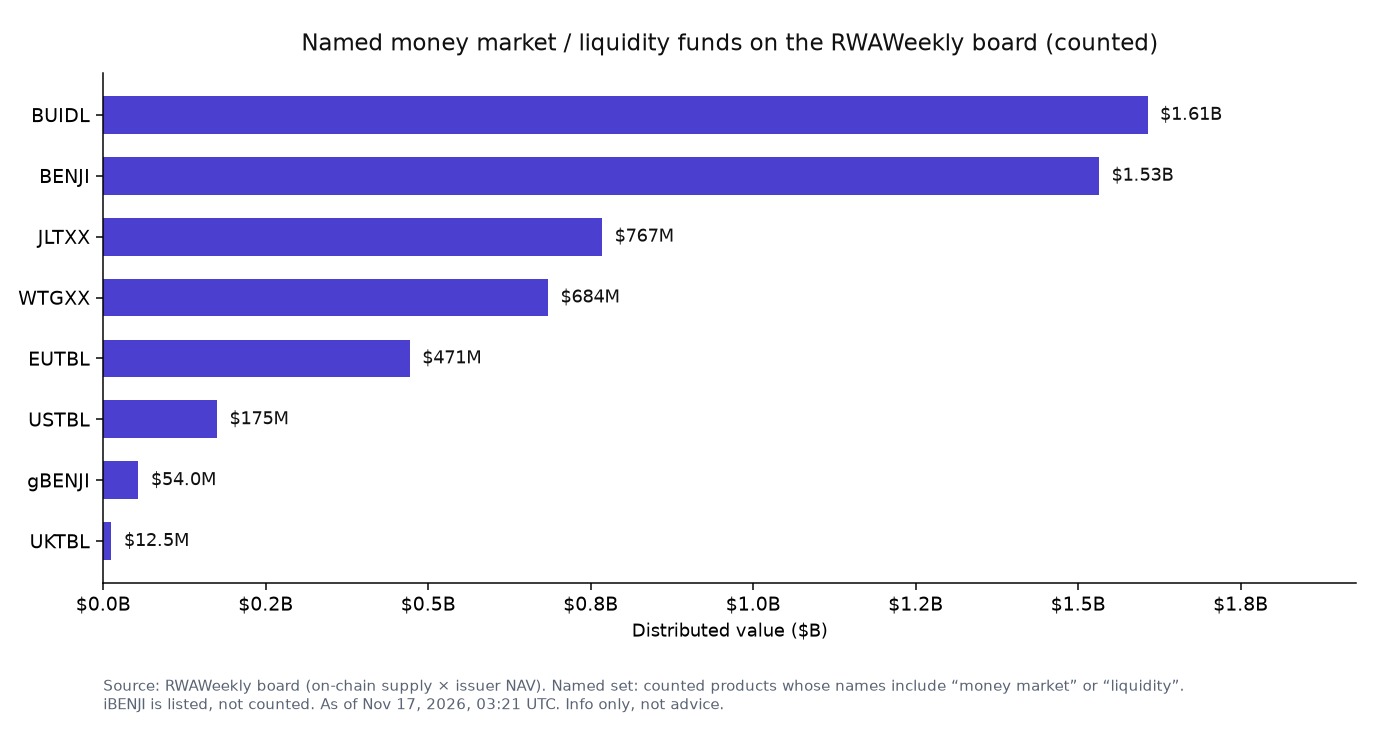
Chart: named money market / liquidity funds on the RWAWeekly board, by distributed value. Source: figures.json, Nov 11, 2026 (11:35 UTC board run). Exact named-set total $5,047,366,555 (eight counted funds; iBENJI listed, not counted). Values are not yields.
Where a share price is meant to stay at $1, income cannot appear as a rising price; issuer documents describe new tokens or later share reinvestment. Where income is retained, the NAV per token rises. Details, fees and timing are in How tokenized Treasury funds pay yield. We do not publish current yields: they change, and they cannot be verified from on-chain supply alone.
How they differ from stablecoins and from some T-bill funds
A major payment stablecoin is typically designed to hold a stable unit value, with reserves set by the issuer's own rules. A tokenized money market fund is a security: a share in a regulated fund that can distribute portfolio income and remains subject to fund law, offering documents and transfer restrictions. In Bulletin No. 115 (26 November 2025), the BIS wrote that tokenized money market funds "offer returns at money market rates and regulatory protections as securities," whereas major stablecoins "are prohibited from paying interest." That is the BIS authors' framing, not a national-statute claim. Stablecoin reserves may themselves include fund shares, which is why our board subtracts identified fund-of-fund holdings (methodology).
Many T-bill products are money market funds; Spiko's T-bills sub-funds are classified as such in the SICAV prospectus. Others use a different wrapper. Superstate's USTB is the Invesco Short Duration US Government Securities Fund, with an accumulating NAV and a $100,000 minimum initial investment unless waived (USTB docs, checked Nov 11, 2026). Ondo's OUSG provides "liquid exposure primarily to short-term US Treasuries, as well as government-sponsored enterprise (GSE) securities" (OUSG overview, checked Nov 11, 2026). Those pages do not name either product as a Rule 2a-7 or EU MMFR money market fund.
Who can hold them, transfers, and collateral use
Eligibility is set by each issuer and by securities law in the holder's jurisdiction, not by a public token contract. BUIDL on Ethereum is available to qualified purchasers with a $5 million minimum on Securitize's product page (BUIDL page). USYC "is available only to entities that are not U.S. Persons, as defined in Regulation S under the Securities Act of 1933" (USYC overview). JLTXX has a $1 million minimum on the Oct 31, 2026 fact sheet. Spiko describes USTBL as open to "All investors" seeking a limited-risk cash investment in US dollars, but only after allowlisting: "Shares of the SICAV can only be held by and transferred between investors with an Allowlisted address" (prospectus, 29 July 2026). Franklin's FOBXX prospectus describes a permissioned whitelist used "to… limit the transferability of Fund shares" (prospectus, Aug 1, 2026). Superstate says USTB "is freely transferable between wallet addresses on the Allowlist" (USTB docs). If a wallet is not allow-listed, the token typically cannot be transferred to it.
Issuer pages also describe subscriptions, redemptions and, where a venue accepts the token, use as collateral. Aave Labs' Horizon market (26 August 2025) lets qualified users supply listed tokenized real-world assets as collateral and borrow stablecoins, with issuer allowlists still applying (Horizon launch; Horizon docs, checked Nov 11, 2026). DTCC-tokenized securities inside bank collateral systems are a different path. This page does not publish loan-to-value ratios, caps or current venue balances.
Current deployments are on each product page. Issuer contract addresses are listed in the sources below.
| Token | Board value | Wrapper, as documented by the issuer |
|---|---|---|
| BUIDL | $1.66B | Institutional digital liquidity fund; seeks $1 NAV; whitelisted transfers |
| BENJI | $1.24B | US government money market fund under Rule 2a-7 (FOBXX prospectus) |
| JLTXX | $767.1M | Intends to qualify as a government money market fund under Rule 2a-7 (issuer fact sheet, Oct 31, 2026) |
| WTGXX | $668.3M | US-registered treasury money market digital fund; seeks $1.00 NAV (SEC prospectus) |
| EUTBL | $475.8M | UCITS; short-term VNAV MMF under Regulation (EU) 2017/1131 |
| USTBL | $174.1M | UCITS; short-term VNAV MMF under Regulation (EU) 2017/1131 |
| gBENJI | $53.0M | Named "UCITS" on the issuer product title we display; see the fund's own UCITS documents |
| UKTBL | $12.8M | UCITS; short-term VNAV MMF under Regulation (EU) 2017/1131 |
Source: RWAWeekly board, Nov 11, 2026 (11:35 UTC board run). Exact named-set total $5,047,366,555. Exact board net total $21,352,006,364 after subtracting $209,760,409 of fund-of-fund holdings. Exact Treasury/government-securities category $10,404,374,467. iBENJI ($1,714,235,491 of on-chain supply) is listed, not counted, and is not in these totals. Wrapper descriptions cite the issuer documents in the sources list. Values are not performance and not a forecast. Info only, not advice. Board data as of Nov 11, 2026.
Sources
- RWAWeekly board / figures.json and methodology, as of Nov 11, 2026 (11:35 UTC board run). iBENJI: issuer Form D/A (signed May 28, 2026; filed Oct 6, 2026).
- SEC Rule 2a-7; EU MMFR (EU) 2017/1131.
- Franklin FOBXX prospectus, Aug 1, 2026 / SEC 485BPOS.
- J.P. Morgan JLTXX fact sheet, Oct 31, 2026.
- WisdomTree WTGXX SEC prospectus (Nov 1, 2025, revised Aug 14, 2026).
- Spiko SICAV prospectus, 29 July 2026.
- Securitize BUIDL page (as-of April 2026 on page).
- Circle USYC overview (checked Nov 11, 2026).
- Superstate USTB; Ondo OUSG overview (checked Nov 11, 2026).
- BIS Bulletin No. 115, 26 Nov 2025.
- Aave Horizon launch (26 Aug 2025) and Horizon docs (checked Nov 11, 2026).
- Issuer contract addresses: BlackRock, WisdomTree, Franklin Templeton, Spiko.
Read next: Tokenized money market funds as collateral · How tokenized Treasury funds pay yield · What is BlackRock BUIDL? · BlackRock BUIDL vs Ondo OUSG · Tokenized Treasuries · Money market funds compared · All products · Methodology · All articles
Get the Friday briefing: tokenized real-world assets, sourced and dated. Subscribe free
Information only. Not financial, investment or legal advice. On-chain value is calculated from public supply and issuer-published NAV or equivalent. Holding a token does not constitute ownership of the underlying asset.
Understand tokenized markets in five minutes.
Get the Friday briefing: what changed, new launches and the regulation that matters, linked to sources.
Subscribe free and get the monthly Tokenized Treasury Fact Sheet (PDF).
Free. Unsubscribe anytime. Information only, not investment advice.
Follow @RWAWeekly for the daily chart: https://x.com/RWAWeekly
Cite this page
RWAWeekly (14 Oct 2026). "Tokenized money market and liquidity funds hold $5.05B on-chain." RWAWeekly. https://rwaweekly.io/articles/tokenized-money-market-funds/
Cite, embed, download: embed the live figures on your site · download the data (CSV, CC BY 4.0) · article feed (Atom) · methodology