How tokenized Treasury funds pay yield
Figures as of Nov 11, 2026. This article is a dated snapshot and its figures are not updated. For current figures, see the live board: USYC, BUIDL, BENJI, WTGXX.
Tokenized Treasury and government-securities funds pass through income from short-term government paper and repurchase agreements in a few different ways. The token is a record of a fund interest, not the bills themselves.
Free Friday briefing: what changed on the board, new launches and regulation, plus the monthly Treasury fact sheet (PDF).
Free. Unsubscribe anytime. Information only, not investment advice.
By the RWAWeekly team · Nov 11, 2026 · Data as of Nov 11, 2026 (11:35 UTC board run)
On the RWAWeekly board, tokenized Treasury and government-securities products hold $10.40B in distributed value — 48.7% of the board's $21.35B net total — as of Nov 11, 2026 (11:35 UTC board run). Franklin's iBENJI is listed on the board but not counted in either figure (why). Distributed value is public token supply multiplied by the issuer-published net asset value (NAV), or an equivalent published price. It is a point-in-time stock figure, not a yield. Issuer documents describe three mechanics for crediting income: an accruing NAV, new tokens at a stable $1 target, or daily declarations generally reinvested later as shares. Holding a token is not the same as owning the underlying Treasuries outright.
Where the income comes from
The portfolio, not the blockchain, produces the income. Issuers describe short-term US government securities, cash and repurchase agreements (repo) — contracts to buy a government security and sell it back at a slightly higher price.
Franklin Templeton's prospectus for the Franklin OnChain U.S. Government Money Fund (ticker FOBXX; token BENJI) says the fund invests at least 99.5% of total assets in government securities, cash and fully collateralized government repo, generally for less than seven days, at a higher price "which reflects prevailing short-term interest rates" (prospectus / SEC filing, Aug 1, 2026). Securitize describes BUIDL's "core investments of overnight repo and 3-month Treasuries" (product page, marked as of April 2026). Superstate says the Invesco Short Duration US Government Securities Fund (USTB) "invests in short-duration U.S. Treasury Bills" (docs, checked Nov 11, 2026). Spiko's SICAV prospectus allows the US T-Bills Money Market Fund (USTBL) to invest up to 100% of net assets in dollar instruments of the US government, including Treasury bills (prospectus, 29 July 2026). Circle's USYC overview says the underlying Hashnote fund "invests primarily in reverse repurchase agreements (reverse repo) backed by U.S. government securities" (Circle docs, checked Nov 11, 2026). Those descriptions are not a promise of a particular rate.
Three ways income shows up in the token
Accruing NAV. The holder keeps the same number of tokens unless they subscribe, redeem or transfer. The NAV per token rises as income is earned, and falls if expenses or losses exceed income. Superstate states that USTB "Return accrues as interest income, reflected in a continuously increasing NAV per share rather than distributions," and that "the token balance does not change" while "the NAV/S increases over time" (USTB; NAV note, checked Nov 11, 2026). Ondo updates OUSG's NAV at the end of each business day "based upon the performance of the underlying investments, along with any accrued fees and/or expenses," and writes that NAV to an on-chain oracle (OUSG overview, checked Nov 11, 2026). Spiko says USTBL's distributable sums "are fully reinvested" — the capitalization, or accumulating, share-class model (prospectus, 29 July 2026). Circle publishes USYC's token price through an on-chain oracle.
New tokens at a stable $1 target. Income cannot appear as a rising price, so it is paid by minting additional tokens. Securitize's BUIDL page says the fund "Seeks a stable $1 NAV" and that "Dividends are accrued each calendar day to the holder of record at 3:00pm ET, and paid out the following business day in the form of new BUIDL tokens" (BUIDL page, as of April 2026 on that page). The $1 figure is a target, not a guarantee: the same page and the March 20, 2024 launch release warn that the fund may not maintain $1.00 at all times. Franklin's BENJI site states that "BENJI accrues yield daily through newly minted BENJI tokens that are airdropped directly into shareholders wallets," with one FOBXX share equal to one BENJI token (Benji site, checked Nov 11, 2026). The FOBXX prospectus adds that the fund declares income dividends each day at its final NAV calculation and uses amortized cost "to seek to maintain a stable $1.00 share price" (prospectus, Aug 1, 2026).
Daily accrual, generally reinvested later as shares. WisdomTree's Treasury Money Market Digital Fund (WTGXX) also seeks a constant $1.00 NAV using amortized cost. Its SEC prospectus (Nov 1, 2025, revised Aug 14, 2026) says the fund "declares dividends of net investment income daily and generally reinvests dividends monthly in full and fractional shares of the Fund," with shareholders sometimes able to elect a different form of payment (SEC prospectus). NAV is calculated on days the US bond market is open, generally as of 4:00 p.m. New York time.
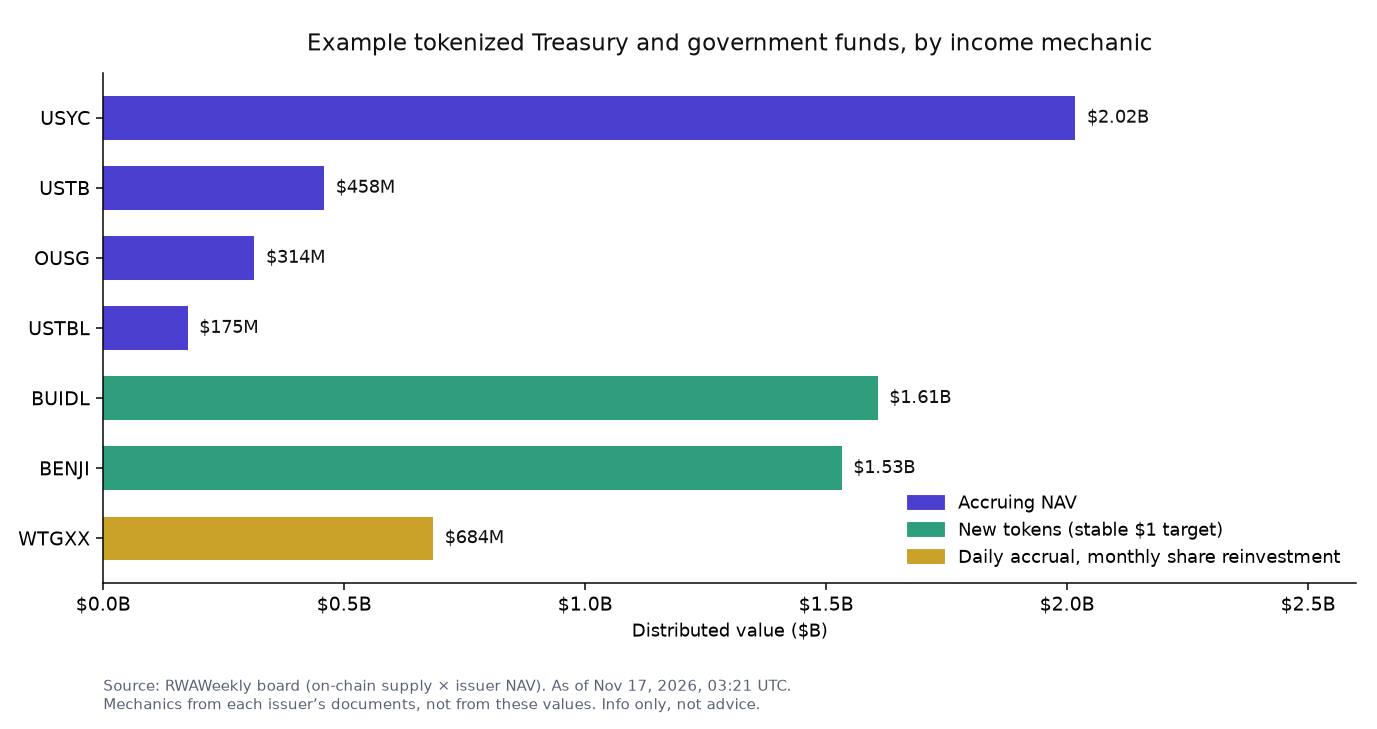
Chart idea (rendered): example funds on the RWAWeekly board, grouped by the income mechanic in each issuer's documents. Source: figures.json, Nov 11, 2026 (11:35 UTC board run). Values are not yields.
Fees and timing
Fees come out of the fund, so they reduce the income that reaches the token. Superstate states that "The fund's management fee accrues into the NAV/S as well, reducing NAV growth" (NAV note). Ondo states a 0.15% management fee for OUSG, "waived until January 1, 2027" (OUSG overview, checked Nov 11, 2026). Spiko lists USTBL management fees of 0.30% including tax, plus operating expenses of up to 0.10% (prospectus, 29 July 2026). Other funds' current fee schedules belong in their own offering documents and can differ by share class.
Timing is fund-specific. BUIDL income accrues each calendar day to the 3:00 p.m. ET holder of record and is paid the next business day as new tokens. BENJI dividends start "on the day the Fund receives your investment" if it arrives in good order before 2 p.m. Pacific time or the fund's final NAV calculation, whichever is earlier (FOBXX prospectus, Aug 1, 2026). USTB's NAV updates continuously, including on non-business days. OUSG updates NAV at the end of each business day. WTGXX generally reinvests a month of daily declarations as additional shares. We do not publish current yields here: they change, and they cannot be verified from on-chain supply alone.
Examples on our board
| Token | Issuer product | Mechanic (issuer docs) | Distributed value |
|---|---|---|---|
| USYC | Circle / Hashnote short-duration yield fund | Accruing token price (on-chain oracle) | $2.10B |
| BUIDL | BlackRock USD Institutional Digital Liquidity Fund | New tokens; seeks $1 NAV | $1.66B |
| BENJI | Franklin OnChain U.S. Government Money Fund (FOBXX) | New tokens; seeks $1.00 share price | $1.24B |
| WTGXX | WisdomTree Treasury Money Market Digital Fund | Daily declaration; generally monthly share reinvestment; seeks $1.00 NAV | $668.3M |
| USTB | Superstate / Invesco short-duration US government securities fund | Continuously increasing NAV; no distributions | $444.0M |
| OUSG | Ondo Short-Term US Government Treasuries | Business-day NAV update to an on-chain oracle | $315.8M |
| USTBL | Spiko US T-Bills Money Market Fund | Accumulating / fully reinvested income | $174.1M |
Source: RWAWeekly board, on-chain supply × issuer-published NAV, as of Nov 11, 2026 (11:35 UTC board run). Exact board net total $21,352,006,364 after subtracting $209,760,409 of fund-of-fund holdings. Exact Treasury/government-securities category $10,404,374,467. iBENJI is listed, not counted, and is not included. Mechanics are summarized from the issuer sources listed below, not from these values. Values are not performance and not a forecast. Info only, not advice.
Sources
- RWAWeekly board / figures.json and methodology, as of Nov 11, 2026 (11:35 UTC board run).
- Securitize BUIDL page (as-of April 2026 on page) and launch release, Mar 20, 2024.
- Franklin FOBXX prospectus, Aug 1, 2026 / SEC 485BPOS; Benji site.
- WisdomTree WTGXX SEC prospectus, Nov 1, 2025, revised Aug 14, 2026.
- Superstate USTB and NAV, income, and yield (checked Nov 11, 2026).
- Ondo OUSG overview (checked Nov 11, 2026).
- Spiko SICAV prospectus, 29 July 2026.
- Circle USYC overview (checked Nov 11, 2026).
Get the Friday briefing: tokenized real-world assets, sourced and dated. Subscribe free
Information only. Not financial, investment or legal advice. On-chain value is calculated from public supply and issuer-published NAV or equivalent. Holding a token does not constitute ownership of the underlying asset.
Understand tokenized markets in five minutes.
Get the Friday briefing: what changed, new launches and the regulation that matters, linked to sources.
Subscribe free and get the monthly Tokenized Treasury Fact Sheet (PDF).
Free. Unsubscribe anytime. Information only, not investment advice.
Follow @RWAWeekly for the daily chart: https://x.com/RWAWeekly
Cite this page
RWAWeekly (11 Nov 2026). "How tokenized Treasury funds pay yield." RWAWeekly. https://rwaweekly.io/articles/how-tokenized-treasury-funds-pay-yield/
Cite, embed, download: embed the live figures on your site · download the data (CSV, CC BY 4.0) · article feed (Atom) · methodology